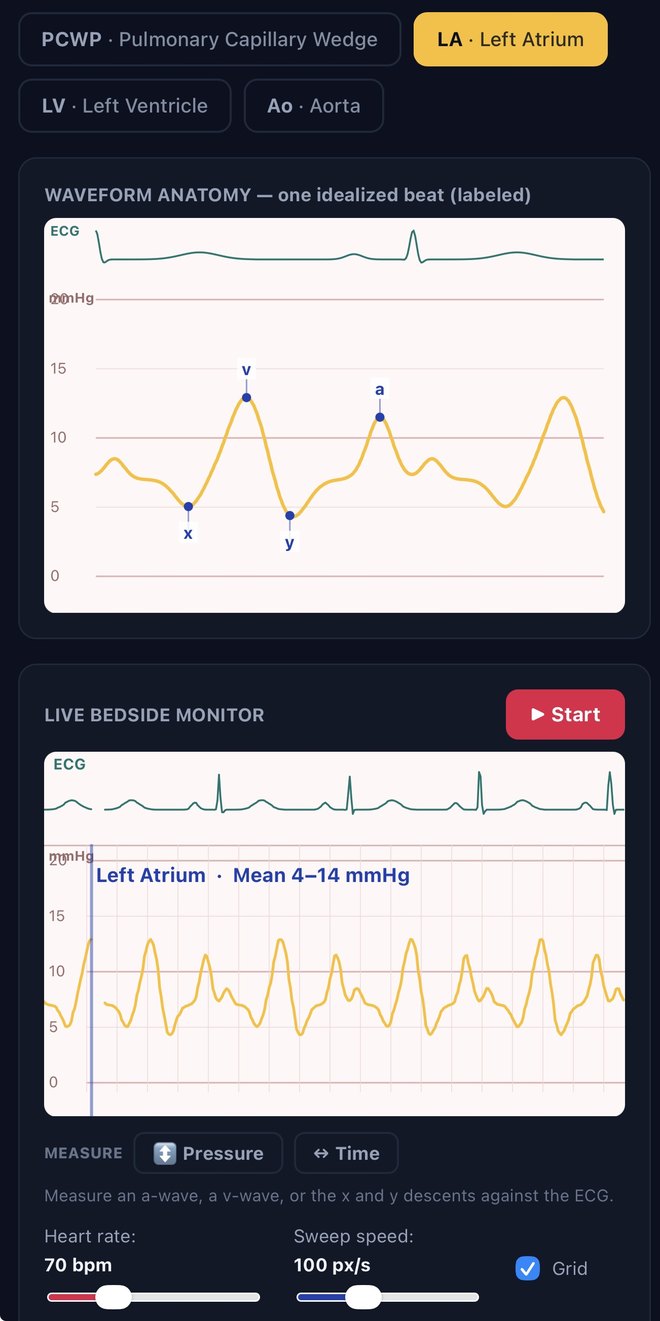
One idealized, labeled beat above a live bedside monitor — every wave tied to the ECG.
Hemodynamics is where a lot of cardiovascular techs get stuck. A pressure tracing on a page is static and abstract; a waveform moving under the sweep, tied to the ECG, is what you actually have to read at the table. This simulator teaches the second one.
What it does
- Every cath lab waveform — right atrium, right ventricle, pulmonary artery, pulmonary capillary wedge, left atrium, left ventricle, and aorta.
- Time-locked to the ECG — each tracing runs beneath a live ECG, so you learn when each wave falls in the cycle, not just its shape.
- Labeled waveform anatomy — one idealized beat with the a wave, v wave, and the x and y descents marked, so the components click.
- Measure against the tracing — drop measurements on an a wave, a v wave, or the x/y descents and read them against the ECG.
- Pullbacks — walk the catheter through the right-heart sequence (RA → RV → PA → wedge) and the LV → aorta pullback, and watch the waveform transform at each step.
- Adjustable — change heart rate and sweep speed to see how the tracing behaves.
What's free, and what's premium
Free: the normal waveforms and the pullback sequences — everything you need to learn to read a normal cath lab study cold. Premium: the pathology library — pulmonary hypertension subtypes (pre-, post-, and combined-capillary) and shunts (ASD, VSD, PDA), where the waveforms tell the diagnosis.
Who it's for
New cath lab techs
Hemodynamics is one of the hardest things to learn from a book. Build real recognition before you're running the monitor during a case.
RCIS candidates
Hemodynamics and pressure measurement are core exam domains. Drill the waveforms until they're automatic.
Monitor-seat trainees
The monitor tech reads the pressures and calls the transitions. This is that skill, practiced safely.
Educators
A live teaching tool for the waveform lecture — far better than static figures on a slide.
Read your first pullback right now.
Open the simulator, pick a chamber, press start. Free, no signup, in your browser.
Part of a bigger pathway
The hemodynamics simulator pairs with our ECG Foundations and Cath Lab Foundations programs — rhythm first, then pressures, then the room. Start free here; go deep when you're ready. For a written companion, the free Cath Lab Field Guide covers the normal pressures and the six core waveforms on a few pages.